
Police Scanner Encryption: Can You Still Listen? (2026 Guide)
Police Scanner Encryption: Can You Still Listen? (2026 Guide)
Can you still hear your local police? Check your agencies, read the RadioReference codes & find the right radio for clear traffic.
Can you still listen if your local police department encrypts its radios? Not to the encrypted transmissions. No consumer police scanner, including the Uniden SDS150 or Uniden SDS100, can turn properly encrypted traffic into understandable audio.
But that doesn't mean scanning is over. Nearby police, fire, EMS, weather, aviation, rail & other services may still transmit in the clear. What matters is your exact department, not a national headline. Here's how to find out what you can hear before buying a scanner.
TL;DR: The short answer
Not sure what's available near you? Tell us your ZIP code & which agencies you want. We'll check what you can actually hear before suggesting a radio.
Get My Free Police Scanner RecommendationWhat can you hear in an encrypted area?
There isn't one answer for an entire city. One department may encrypt tactical channels but keep dispatch clear. Another may encrypt all police traffic while neighboring fire or EMS channels stay open.
| Local situation | What remains available | Worth buying? |
|---|---|---|
| Dispatch is clear | Dispatch & other supported unencrypted traffic | Usually, if your scanner supports the system |
| Only tactical channels are encrypted | Clear dispatch & any other open talkgroups | Often yes, with realistic expectations |
| Mixed encryption on one talkgroup | Only the clear portion of each conversation | Maybe, but expect gaps |
| Every channel you want is encrypted | None of those channels | No, if those are your only interest |
| Police encrypted, other services clear | Potentially fire, EMS, aviation, rail & weather | Yes, if those are your interests |
Practical rule: Shop for the channels you can actually hear, not a scanner's biggest feature list.
Is my metro encrypted? Check 30 major U.S. areas
The most useful part of our original guide is back. Pick a metro below to open its representative county page on RadioReference. From there, check your exact agency, system & talkgroup.
Important: These links do not mean an entire metro is encrypted or clear. Metro areas cross county lines, radio policies change & a county can have dozens of independently operated agencies. The list is a navigation shortcut, not a current encryption-status ranking.
| # | Metro area | Open RadioReference |
|---|---|---|
| 1 | New York - Newark | New York City County |
| 2 | Los Angeles - Long Beach - Anaheim | Los Angeles County |
| 3 | Chicago - Naperville | Cook County |
| 4 | Dallas - Fort Worth - Arlington | Dallas County |
| 5 | Houston - The Woodlands - Sugar Land | Harris County |
| 6 | Washington, DC - Arlington - Alexandria | Washington, DC |
| 7 | Philadelphia - Camden - Wilmington | Philadelphia County |
| 8 | Miami - Fort Lauderdale - West Palm Beach | Miami-Dade County |
| 9 | Atlanta - Sandy Springs - Alpharetta | Fulton County |
| 10 | Phoenix - Mesa - Chandler | Maricopa County |
| 11 | Boston - Cambridge - Newton | Suffolk County |
| 12 | San Francisco - Oakland - Berkeley | San Francisco County |
| 13 | Riverside - San Bernardino - Ontario | Riverside County |
| 14 | Detroit - Warren - Dearborn | Wayne County |
| 15 | Seattle - Tacoma - Bellevue | King County |
| 16 | Minneapolis - St. Paul - Bloomington | Hennepin County |
| 17 | San Diego - Chula Vista - Carlsbad | San Diego County |
| 18 | Tampa - St. Petersburg - Clearwater | Hillsborough County |
| 19 | Denver - Aurora - Lakewood | Denver County |
| 20 | Baltimore - Columbia - Towson | Baltimore County |
| 21 | St. Louis | St. Louis County |
| 22 | Charlotte - Concord - Gastonia | Mecklenburg County |
| 23 | Orlando - Kissimmee - Sanford | Orange County, FL |
| 24 | San Antonio - New Braunfels | Bexar County |
| 25 | Portland - Vancouver - Hillsboro | Multnomah County |
| 26 | Sacramento - Roseville - Folsom | Sacramento County |
| 27 | Pittsburgh | Allegheny County |
| 28 | Las Vegas - Henderson - Paradise | Clark County |
| 29 | Cincinnati | Hamilton County |
| 30 | Kansas City | Jackson County |
Can't find your city or agency in that list? Search RadioReference directly or let us check it for you.
How to check whether your local police are encrypted
You can figure this out yourself in a few minutes. We'll walk through it using real screenshots retained from the original guide. The screenshots are historical examples, not live encryption reports. Always trust today's database entries over an old picture.
Step 1. Find your state & county
Open the RadioReference frequency database, select your state, then choose your county. You can also start with a metro link above. A large metro may have separate cities, counties & systems, so locate the agency you actually want to monitor.
Step 2. Open the agency's radio system
Look for the police or sheriff category, or open the linked trunked system. A P25 system may have separate talkgroups for Dispatch, Tac, Records, Fire & EMS. Don't assume everything on the system shares one encryption setting.

Step 3. Find the Mode column & read the talkgroups
The example below is an older San Bernardino County sheriff talkgroup screenshot. The highlighted DE entries show encrypted digital talkgroups; the D entries illustrate digital traffic that isn't marked encrypted. The exact 2026 status may differ.

Step 4. Compare the services you care about
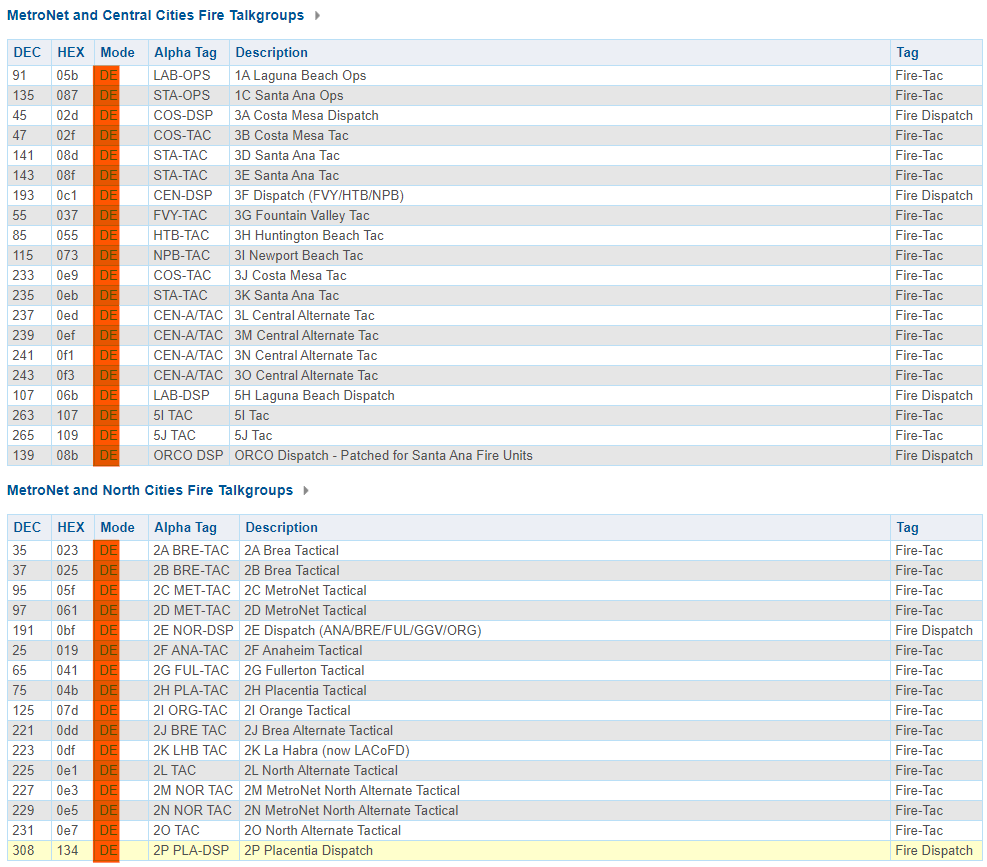
Check police dispatch separately from police tactical, fire, EMS & neighboring departments. In the historic Orange County Fire Authority example below, the highlighted cells illustrate why examining individual talkgroups matters.
Step 5. Confirm before buying
RadioReference is community maintained, so a recent system change may not be reflected immediately. Read the site's latest updates, check credible local reports & ask us to double-check before spending money.
Fastest route: Give us your ZIP code & agency names. We'll check encryption, simulcast & scanner compatibility for free.
Tell us what you want to hearRadioReference: four things to double-check before buying
Radio databases change. Use today's RadioReference database, not a screenshot from years ago.
- Find the actual agency. Start with your state & county, then locate the police, sheriff, fire or EMS department you care about. The county page may link to a separate trunked radio system.
- Check the system & site. A frequency or talkgroup only helps when the scanner supports the radio system & can receive an appropriate nearby site.
- Read the Mode column. A digital mode doesn't necessarily mean encryption. Look for encrypted talkgroup indicators, and verify whether the specific dispatch or tactical channel is affected.
- Look for recent updates. Agencies can change systems, encryption policies or talkgroup use. Recheck the database and the relevant local forum before ordering.
RadioReference Mode codes: D, T, DE & TE
The Mode column identifies the signal type. These are common entries you'll see on current or historical RadioReference system pages.
| Mode | Meaning | Can a scanner hear it? |
|---|---|---|
| A / FM / FMN | Analog voice | Usually yes, with correct coverage & programming |
| D | Digital FDMA voice, typically P25 Phase I | Yes if clear & supported |
| T | TDMA digital voice, commonly P25 Phase II | Yes if clear & supported |
| DE / TE | Digital / TDMA encryption indicators | Not the encrypted audio |
| De / Te | Often indicates intermittent or mixed encryption in displayed listings | Only any transmission in the clear |
Remember: P25, DMR, NXDN & ProVoice describe radio formats. They aren't passwords. An appropriate Uniden software upgrade may enable reception of a supported unencrypted DMR, NXDN or ProVoice system. It will never unlock encrypted traffic.
For field definitions, consult the RadioReference database & the relevant system notes. Database codes summarize system use; they aren't a guarantee that every live transmission will follow that label.
P25, digital, simulcast & encryption are not the same
P25 / digital describes how the voice is transmitted. A compatible digital scanner can follow supported clear digital calls.
Encryption scrambles voice so an unauthorized radio can't turn it back into intelligible sound. A consumer scanner can't bypass it.
Simulcast means multiple transmitter sites broadcast coordinated signals. Some scanners struggle to decode that overlap, even when the conversations are clear. The SDS150 & SDS100 are designed for difficult simulcast conditions, but neither gets around encryption.
Read our simulcast distortion guide for more on the difference.
Real-world case studies: Why local details matter
Denver, Colorado: Police radios went dark
Denver Police encrypted its primary radio traffic in 2019. Local news outlets objected to losing live access. Colorado subsequently adopted a law requiring an access policy for accredited news media when a law enforcement agency encrypts all its radio communications. That media-access policy doesn't give a consumer scanner an encryption key. Denver media-access reporting | Colorado law
Dallas, Texas: One metro, different decisions
The Dallas area is a good example of mixed access. A City of Dallas briefing described its dispatch channels as unencrypted, while other area agencies use encryption on some or all channels. Don't treat Dallas County or the entire DFW metro as one radio policy. Open Dallas County on RadioReference & check the exact agency, including its current talkgroup entries.
Orange County, California: Historic screenshots can mislead
The original article discussed a fire-radio decryption proposal & included Orange County screenshots. They still help explain how to read a system, but they're not proof that Orange County Fire Authority dispatch is clear today. Use the current Orange County database to check each agency. These archived examples show how the source data can change.
The older statewide screenshots below are also retained as visual examples. They do not establish that every Florida or Pennsylvania state police transmission is currently encrypted.


Why do departments encrypt police radios?
Agencies commonly cite officer safety, privacy, sensitive records & protecting investigative operations. Critics point to the loss of timely reporting, accountability & public awareness. The tradeoffs are real. So are the differences between communities.
Some departments leave routine dispatch clear, encrypt only investigative channels, provide access to approved news organizations or publish delayed official feeds. There's no nationwide standard, which is why checking the local system matters more than assuming all police radio is available or unavailable.
Can an app, SDR or programming service beat encryption?
No. A smartphone scanner app doesn't bypass encryption. Apps such as Broadcastify replay audio supplied by agencies or feed volunteers, where authorized & available. Some feeds are live; others are delayed. Coverage is not guaranteed.
An SDR receiver, paid scanner software, expert programming or a DMR/NXDN upgrade doesn't provide the missing encryption key. Even if your receiver detects an encrypted talkgroup, that isn't the same as hearing the conversation.
What can you still listen to?
Depending on the local system, you may still hear clear police dispatch, neighboring agencies, fire, EMS, NOAA weather, civil aviation, railroad, marine, amateur radio & other supported services. Each varies by location, antenna, signal format & what the agency chooses to transmit openly.
If a single fully encrypted police department is your only goal, do not buy a scanner expecting it to fix the problem. If you want to listen to multiple services, a well-chosen scanner can still deliver plenty of value.
Which police scanner should you buy?
First check that the channels you want are clear. Then choose a radio that supports the system. Neither option below decrypts encrypted communications.
 SDS150
Uniden SDS150: Premium handheld for challenging P25 & simulcast. Built-in GPS, USB-C charging, app controls & an included charging cradle make it a strong option for traveling across coverage areas. Shop the Uniden SDS150.
Check live price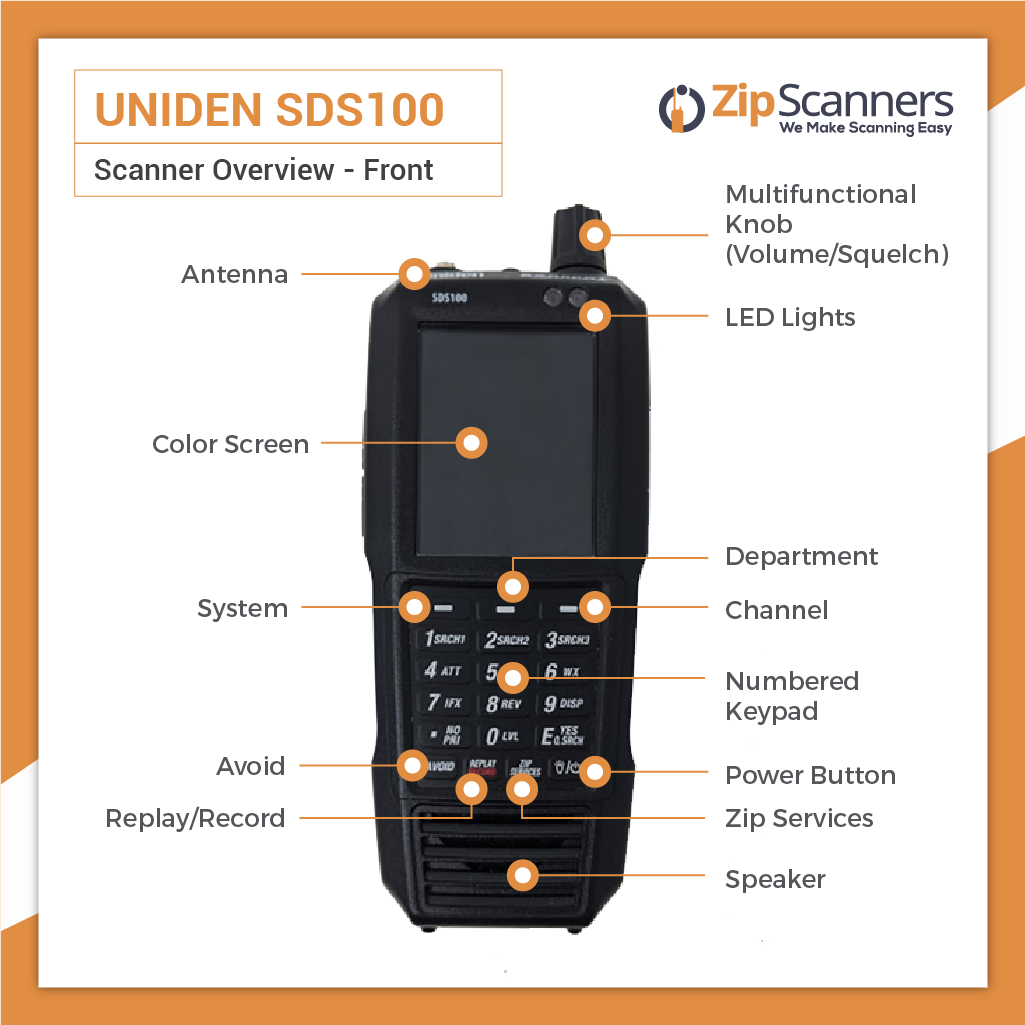 SDS100
Uniden SDS100: Proven True I/Q handheld at a lower price. A great fit if you value capable simulcast reception but don't need the newer GPS, charging & app conveniences. Shop the Uniden SDS100.
Check live priceIf you only need clear analog channels, there may be a less expensive radio that does the job. Tell us your ZIP code before choosing a premium digital model.
Want the full feature comparison? Read our SDS150 vs SDS100 buying guide.
Watch: See the scanners in action
These newer Zip Scanners demonstrations show the SDS150's hardware & setup. They're product walk-throughs, not demonstrations of decrypting police traffic.
Frequently asked questions
Can the SDS150 or SDS100 decode police encryption?
No. The SDS150 & SDS100 follow supported unencrypted radio systems. They cannot turn encrypted traffic into understandable voice.
Does P25 Phase II mean my department uses encryption?
No. P25 Phase II is a digital radio format. Encryption is a separate policy & system setting.
What do DE, TE, De & Te mean on RadioReference?
These codes identify digital modes with encryption or mixed encryption in many displayed listings. Check the system's legend & description. Only the transmissions in the clear can be heard by a consumer scanner.
Are all Broadcastify feeds delayed by 30 minutes?
No. Some are live, some are delayed & others are unavailable. Check that feed's description.
Does a DMR or NXDN upgrade unlock an encrypted talkgroup?
No. Uniden software upgrades support compatible unencrypted formats. Encryption remains inaccessible.
Can I still hear fire & EMS when police go encrypted?
Sometimes. Fire & EMS may share a system but use different talkgroups or encryption policies. Check each service separately.
Can I listen to a nearby county instead?
Possibly, if the neighboring agency transmits in the clear, the signal reaches you & your scanner supports the system.
What if a RadioReference listing looks outdated?
Look for recent updates, confirm the agency & talkgroup, then ask us to research the area before purchasing.
Is owning a police scanner legal?
Generally, listening to radio transmissions readily accessible to the public is permitted in the U.S., but certain states restrict use in vehicles or in connection with criminal activity. Read our scanner legality guide & check local law. This is general information, not legal advice.
Which scanner should I buy if my police dispatch is fully encrypted?
If that specific encrypted dispatch is your only interest, none. If fire, EMS, neighboring agencies or other clear services interest you, get a free police scanner recommendation based on those signals.
The bottom line
Encryption is a hard stop for the affected channels, but not necessarily for the rest of the radio dial. Check your exact agency, examine the current RadioReference talkgroups & decide what you still want to hear.
We'll do the research for free. Tell us your ZIP code, specific departments & listening goals. We'll explain what is open, what is encrypted & which scanner (if any) makes sense.
Find out what you can actually hear
We will check your local agencies before recommending a radio.
Get My Free Police Scanner RecommendationSources & further reading
- RadioReference database for counties, frequencies, trunked systems & talkgroups
- RadioReference current radio system listings for local system and talkgroup research
- Colorado media-access policy law
- City of Dallas / North Texas radio system
- Broadcastify online feeds
- Uniden SDS150 support & features