
Police Codes & 10-Codes: Full List, Meanings & Printable Charts
THE ZIP SCANNERS REFERENCE LIBRARY
Police Codes & 10-Codes: Full List, Meanings & Printable Charts
Police radio codes turn common messages into short numbers. You've probably heard 10-4 or "What's your 20?" But what do they actually mean?
Look up common 10-codes, 11-codes, signal codes and the phonetic alphabet using the full-size reference charts and searchable text tables below.
Find what you need
Police Codes Master Reference Chart
This master graphic brings the code families together. Open it full-size to read the details, save it to your phone or share it with attribution.

Watch: Police Codes Explained
Prefer a quick explanation before the tables? This is our Police Codes Explained video. One video, then straight to the reference.
Police 10-Codes: Full List & Meanings
Ten-codes make radio traffic shorter: 10-4 often means "message received," while 10-20 commonly means "location." APCO describes the earliest 10-code standardization efforts in 1937, with later revisions. Departments adapted meanings, so treat this as a reference, not your agency's operational rulebook.
The original three 10-code infographics are preserved below, in full-size, shareable form.


Search all 100 ten-codes
| Code | Meaning | Notes |
|---|---|---|
| 10-0 | Caution | Use with discretion |
| 10-1 | Unable to copy | Signal weak |
| 10-2 | Signal good | - |
| 10-3 | Stop transmitting | Cease radio traffic |
| 10-4 | Acknowledgment (OK) | Most famous |
| 10-5 | Relay | Transmit to another unit |
| 10-6 | Busy | Stand by |
| 10-7 | Out of service | Off duty / fuel |
| 10-8 | In service | Available |
| 10-9 | Repeat | Say again |
| 10-10 | Fight in progress | High priority |
| 10-11 | Dog case | Animal control |
| 10-12 | Stand by / Visitors present | Sensitive info |
| 10-13 | Weather conditions | Road report |
| 10-14 | Escort / Convoy | - |
| 10-15 | Prisoner in custody | - |
| 10-16 | Pick up prisoner | Transport request |
| 10-17 | Pick up papers | Documents |
| 10-18 | Urgent | Complete quickly |
| 10-19 | Return to station | HQ |
| 10-20 | Location | “What’s your 20?” |
| 10-21 | Call by telephone | Phone contact |
| 10-22 | Disregard | Cancel assignment |
| 10-23 | Arrived at scene | On location |
| 10-24 | Assignment completed | - |
| 10-25 | Report in person | Meet at HQ or scene |
| 10-26 | Detaining subject | Subject held |
| 10-27 | Driver-license info | Request check |
| 10-28 | Vehicle registration | Plate lookup |
| 10-29 | Check for wanted | Warrants / stolen |
| 10-30 | Illegal use of radio | Unnecessary traffic |
| 10-31 | Crime in progress | - |
| 10-32 | Man with gun | Armed subject |
| 10-33 | Emergency - stand by | Radio priority |
| 10-34 | Riot | Civil disturbance |
| 10-35 | Major crime alert | - |
| 10-36 | Correct time | Request / provide |
| 10-37 | Suspicious vehicle | Or subject |
| 10-38 | Stopping suspicious vehicle | Code 5 stop |
| 10-39 | Urgent - lights & siren | Code 3 |
| 10-40 | Silent run - no lights | Code 2 |
| 10-41 | Begin shift | - |
| 10-42 | End shift | - |
| 10-43 | Information | Message |
| 10-44 | Permission to leave | Break / coffee |
| 10-45 | Animal carcass | Road hazard |
| 10-46 | Assist motorist | Disabled vehicle |
| 10-47 | Emergency road repairs | - |
| 10-48 | Traffic standard repair | - |
| 10-49 | Traffic light out | - |
| 10-50 | Accident (F/PI/PD) | Fatal/Injury/Damage |
| 10-51 | Wrecker needed | Tow truck |
| 10-52 | Ambulance needed | - |
| 10-53 | Road blocked | - |
| 10-54 | Livestock on highway | - |
| 10-55 | Drunk driver | DUI suspect |
| 10-56 | Intoxicated pedestrian | - |
| 10-57 | Hit & run | - |
| 10-58 | Direct traffic | - |
| 10-59 | Convoy / escort | - |
| 10-60 | Squad in vicinity | - |
| 10-61 | Personnel in area | - |
| 10-62 | Reply to message | - |
| 10-63 | Prepare to copy | - |
| 10-64 | Message for local delivery | - |
| 10-65 | Net message assignment | - |
| 10-66 | Missing person | - |
| 10-67 | Clear to read net message | - |
| 10-68 | Dispatch information | - |
| 10-69 | Message received | - |
| 10-70 | Fire alarm | - |
| 10-71 | Advise nature of fire | - |
| 10-72 | Report progress of fire | - |
| 10-73 | Smoke report | - |
| 10-74 | Negative | No |
| 10-75 | In contact with | Subject / unit |
| 10-76 | En-route | - |
| 10-77 | ETA | Estimated arrival |
| 10-78 | Need assistance | Officer needs help |
| 10-79 | Notify coroner | - |
| 10-80 | Chase in progress | Pursuit |
| 10-81 | Breathalyser report | Intox test |
| 10-82 | Reserve lodging | - |
| 10-83 | School crossing duty | - |
| 10-84 | If meeting ___, advise ETA | - |
| 10-85 | Delayed due to ____ | - |
| 10-86 | Officer on duty | - |
| 10-87 | Pickup/distribute checks | - |
| 10-88 | Advise phone number | - |
| 10-89 | Bomb threat | - |
| 10-90 | Bank alarm | - |
| 10-91 | Prowler | - |
| 10-92 | Improperly parked vehicle | - |
| 10-93 | Blockade | Road closed |
| 10-94 | Drag racing | - |
| 10-95 | Prisoner in custody | - |
| 10-96 | Mental subject | - |
| 10-97 | Check (test) signal | Radio check |
| 10-98 | Assignment finished | Available |
| 10-99 | Wanted / stolen indicated | Hit confirmation |
These are reference meanings. Your local agency's definitions may be different.
New to radio terminology? Read the Beginner's Guide to Police Scanners.
Police 11-Codes: Common Examples
Some public-safety departments use eleven-codes, particularly around traffic, transport and dispatch. There is no single nationwide list that applies everywhere.

Search the 11-code list
| Code | Meaning |
|---|---|
| 11-10 | Take report |
| 11-12 | Dead animal |
| 11-24 | Abandoned vehicle |
| 11-25 | Traffic hazard |
| 11-26 | Disabled vehicle |
| 11-27 | DL check - wants/warrants |
| 11-28 | Vehicle registration check |
| 11-40 | Advise if ambulance needed |
| 11-41 | Ambulance needed |
| 11-44 | Fatality (coroner) |
| 11-48 | Furnish transportation |
| 11-51 | Escort |
| 11-52 | Funeral detail |
| 11-54 | Suspicious vehicle |
| 11-55 | Officer being followed |
| 11-56 | Citizen being followed |
| 11-79 | TC - ambulance en-route |
| 11-80 | TC - major injury |
| 11-81 | TC - minor injury |
| 11-82 | TC - property damage |
| 11-83 | TC - unknown injuries |
| 11-84 | Direct traffic |
| 11-85 | Tow truck needed |
| 11-86 | Special detail |
| 11-87 | Assist fire department |
| 11-98 | Meet at location |
| 11-99 | Officer needs help (urgent) |
These are reference meanings. Your local agency's definitions may be different.
Police Signal Codes: Common Meanings
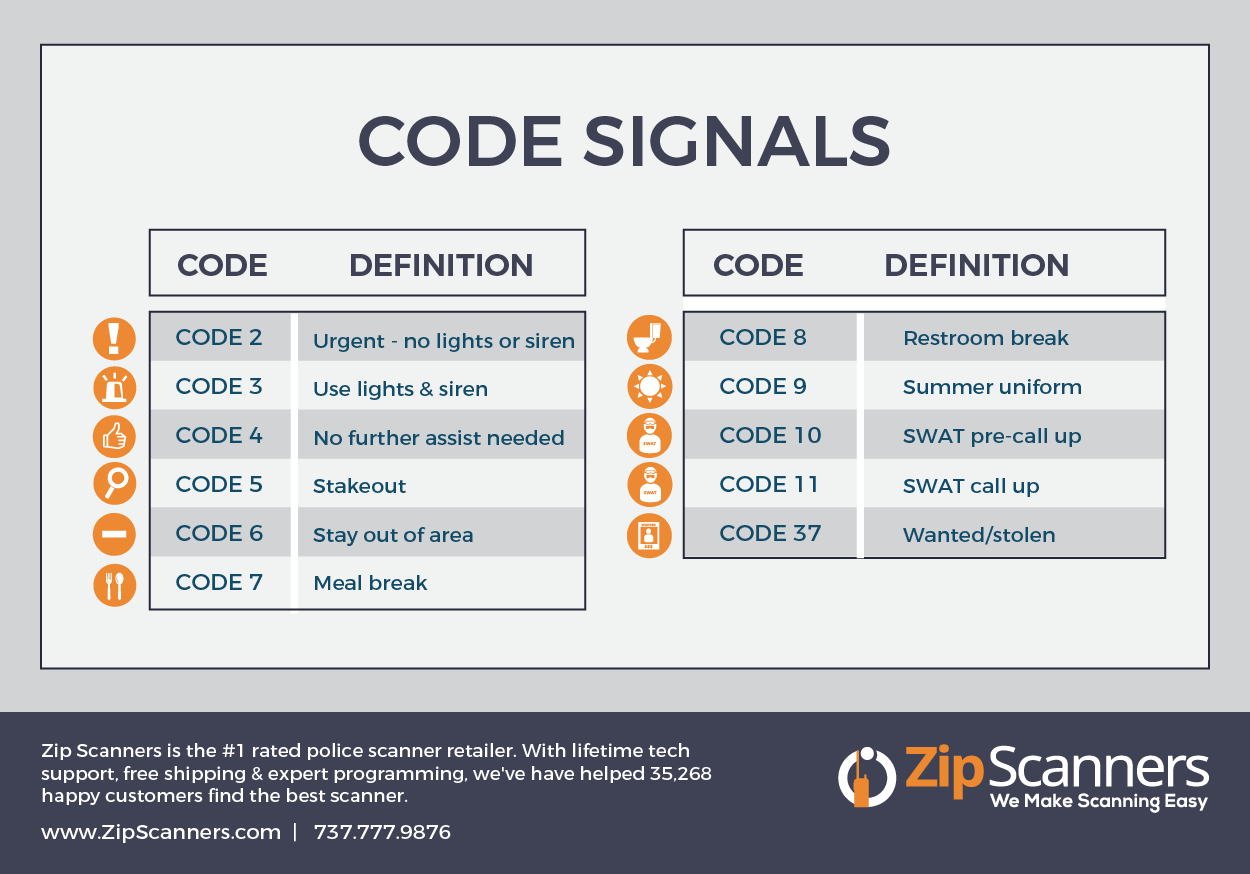
Some departments use numbered signals instead of, or alongside, 10-codes. The number often tells a dispatcher the type of call, but those numbers are especially local. Signal 100 is not universal. This original chart lists it as "Resume normal traffic," but another department may use a different definition.
Search all 46 signal-code examples
| Signal | Meaning |
|---|---|
| 1 | Drunk driver |
| 2 | Intoxicated person |
| 3 | Hit & run |
| 4 | Accident |
| 5 | Murder |
| 6 | Escaped prisoner |
| 7 | Dead body |
| 8 | Missing person |
| 9 | Stolen vehicle |
| 10 | Stolen items |
| 11 | Hit & run - injury |
| 12 | Reckless driving |
| 13 | Suspicious person |
| 14 | Information |
| 15 | Special detail |
| 16 | Domestic disturbance |
| 17 | Complaint |
| 18 | Felony in progress |
| 19 | Misdemeanor |
| 20 | Mental subject |
| 21 | Burglary in progress |
| 22 | Disturbance |
| 23 | Hold-up |
| 24 | Prowler |
| 25 | Fire |
| 26 | Detain subject |
| 27 | License check |
| 28 | Registration check |
| 29 | Reckless driver |
| 30 | Bomb threat |
| 31 | Crime in progress |
| 32 | Gun involved |
| 33 | Emergency - radio silence |
| 34 | Assault |
| 35 | Rape |
| 36 | Shooting |
| 37 | Stabbing |
| 38 | Officer in danger |
| 39 | Road block |
| 40 | Fight |
| 50 | Dispatch duty |
| 60 | Open door / window |
| 70 | Improper parking |
| 80 | Explosion |
| 90 | Hostage situation |
| 100 | Resume normal traffic |
These are reference meanings. Your local agency's definitions may be different.
Police Phonetic Alphabet: A to Z
Radio operators use spoken words to distinguish similar-sounding letters in names, license plates and callsigns. The internationally standardized NATO/ICAO list uses Alfa, Bravo, Charlie. Older public-safety alphabets and individual agencies may use different words.
The original Zip Scanners illustration stays intact; the searchable text table uses official spellings, including Alfa and Juliett. See NATO's official alphabet.

Search all 26 letters
| Letter | Word |
|---|---|
| A | Alfa |
| B | Bravo |
| C | Charlie |
| D | Delta |
| E | Echo |
| F | Foxtrot |
| G | Golf |
| H | Hotel |
| I | India |
| J | Juliett |
| K | Kilo |
| L | Lima |
| M | Mike |
| N | November |
| O | Oscar |
| P | Papa |
| Q | Quebec |
| R | Romeo |
| S | Sierra |
| T | Tango |
| U | Uniform |
| V | Victor |
| W | Whiskey |
| X | X-ray |
| Y | Yankee |
| Z | Zulu |
These are reference meanings. Your local agency's definitions may be different.
Free printable police codes downloads
Keep a reference next to your scanner or open these lists in Excel and Google Sheets. No email address required.
All 199 reference entries in one spreadsheet-ready file.
Download full CSV100 numbered ten-codes, meanings and notes.
Download 10-Codes27 eleven-code examples.
Download 11-Codes46 example signal meanings.
Download Signals26 official NATO/ICAO letter words.
Download PhoneticsUse your browser's print dialog and choose Save as PDF. This button opens the browser's print dialog, where you can save a PDF.
PNG: open any original chart above, then use Save Image As on desktop or long-press to save on mobile. If your browser blocks a CSV download, select the reference table and copy it into a spreadsheet.
Why Do Police Use Radio Codes?
Early police radio channels were limited, and short standardized signals helped dispatchers and officers exchange routine messages efficiently. According to APCO International's project history, work on familiar 10-codes began in 1937; standards later appeared in its 1967 Project 2 and 1974 Project 14 revisions.
Why codes vary across departments
Codes spread over time, but departments changed meanings to match their local procedures. The result is useful shorthand for regular users, yet potentially confusing when agencies work together. Knowing a code in one city does not guarantee that the same number means the same thing across a county line.
Why plain language matters in emergencies
During incidents involving multiple organizations, responders need terminology everyone can understand. FEMA's National Incident Management System training recommends clear, plain language rather than agency-specific radio codes. This does not mean everyday ten-codes have vanished from routine police communication.
Codes aren't encryption
A radio code is a spoken shortcut; encryption is a technical barrier to decoding a transmission. A receiver that hears a clear voice may recognize a code, but it cannot recover encrypted audio by memorizing the code list. See our police scanner encryption guide for the distinction.
Police Codes: Frequently Asked Questions
What does 10-4 mean?
In many common radio-code lists, 10-4 acknowledges that a message was received or understood.
What does 10-20 mean?
It commonly asks for or reports a location. You might hear someone say, "What's your 20?"
What does 10-33 mean?
Many lists use 10-33 for emergency or priority radio traffic. Always confirm the definition for the agency you're monitoring.
Do all police departments use the same codes?
No. Numbered codes can differ between departments, counties and states. An official local list is more reliable than any generic reference.
What are 11-codes?
Additional radio shorthand used by some public-safety agencies, often for traffic and dispatch matters. They are not nationally uniform.
What are police signal codes?
Short numbered signals used for incidents or instructions by individual agencies. Signal meanings are particularly location-specific.
What does Signal 100 mean?
There is no universal definition. The signal-code example table on this page lists Signal 100 as "Resume normal traffic," but some departments use the same number for other instructions. Verify the specific agency.
Are police codes encrypted?
No. Codes are spoken shorthand; radio encryption is a separate technology that prevents unauthorized receivers from decoding audio.
Why did responders switch toward plain language?
Codes that mean different things in neighboring jurisdictions can create dangerous misunderstandings. FEMA NIMS calls for plain language during multi-agency incidents.
Are police 10-codes being phased out?
Some agencies use plain language more often while others continue using codes for routine communications. There is no single nationwide elimination of all 10-codes.
What is the difference between police codes and penal codes?
Radio codes are shortcuts for communication. Penal codes refer to laws and offenses, not instructions spoken over a radio.
Do fire and EMS agencies use the same codes?
Sometimes agencies share common signals, but fire and EMS departments may have their own terms and protocols.
How do I find my local agency's code list?
Check the department or dispatch agency website, official documents and published radio communications policies. Local sources take precedence.
Can a police scanner hear every department?
No. It depends on whether the radio supports that agency's system, whether reception is possible and whether the transmissions are encrypted.
Where can I download printable police codes?
Use the Download Center above for separate 10-code, 11-code, signal-code and phonetic CSVs, plus the combined spreadsheet-ready list. To make a PDF of the whole page, choose Print / Save as PDF.
Can I share the original graphics?
Yes. Share the intact original Zip Scanners charts with attribution and a link back to this guide.
Official sources & references
These sources support the background, interoperability and phonetic sections. The code lists are common reference examples, not a claim of official endorsement by these organizations.
- APCO International: radio standards and ten-code project history
- FEMA NIMS: common terminology, plain language and interoperability
- NATO: official phonetic alphabet and history
- FAA: published radiotelephony phonetic alphabet
To confirm a code you heard locally, consult your own agency's official communications policy or published dispatch code list.
Want to actually listen to police radio?
Understanding the codes is one thing. Finding a scanner compatible with your local radio system is another. We'll help you verify what can be received in your area, including digital systems and encryption limits.
Learn more: Are police scanners legal? · Police scanner programming guide
Reference charts by Zip Scanners. Original artwork remains unchanged. Individual agencies may use different radio-code meanings.