Best Police Scanner for California: What Works in Your County
State Scanner Guide • 2026 Edition
Best Police Scanner for California: What Works in Your County
P25 Phase II. Aggressive simulcast. Encryption spreading fast in major metros. California is one of the most complex states in the country to scan. Here is what you need to know before you buy.
California is not one radio landscape. It is 58 counties with wildly different systems, frequencies, and encryption policies. The Los Angeles basin runs multi-site P25 Phase II simulcast that will eat a cheap scanner alive. The Bay Area has some of the most congested RF environments on the west coast. Several major departments in San Diego encrypted in 2025. Meanwhile, plenty of rural Central Valley and Northern California counties still run clear P25 or even analog conventional.
If you walk into a big box store and grab the first scanner on the shelf, there is a real chance it will not work right in your county. This guide will fix that. We will break down every major region, name the systems that are actually running, flag where encryption has hit, and tell you exactly which scanner to buy.
Before you buy anything: Always verify your county's current system on RadioReference.com. Look up your county, find your local P25 system, and check the talkgroup list. Talkgroups marked "E" are encrypted. No scanner defeats AES-256 encryption.
Why California Is Different
Three things separate California from most other states for scanner users:
Most major metro counties run P25 Phase II trunked systems. Phase II uses TDMA technology, which puts two voice calls on a single frequency slot. Older scanners that handle Phase I only will miss half the traffic or decode garbled audio on a Phase II system.
Southern California in particular uses wide-area simulcast networks where multiple tower sites transmit the same signal simultaneously. When a scanner picks up two towers at slightly different timing, you hear noise instead of speech. This is simulcast distortion, and it is the single biggest reason people quit scanning in California. Only scanners with True I/Q digital receivers handle it cleanly.
San Diego Police went fully encrypted in June 2025. LAPD operates encrypted tactical channels. Orange County law enforcement has been fully encrypted for years. The pattern in California mirrors national trends: the larger the metro and the newer the P25 infrastructure, the faster agencies flip to encryption.
"The SDS series is exactly what you are asking for... They have an SDR chip that allows them to work very well with simulcast distortion." — RadioReference.com forum, 2024
Source: RadioReference Forums
The Right Scanner for California
To handle California's simulcast-heavy, P25 Phase II environment reliably, you need a True I/Q digital receiver. There are two scanners we recommend for California buyers in 2026. Which one is right for you depends on budget and how you plan to use it.
Uniden SDS150 — Best Overall
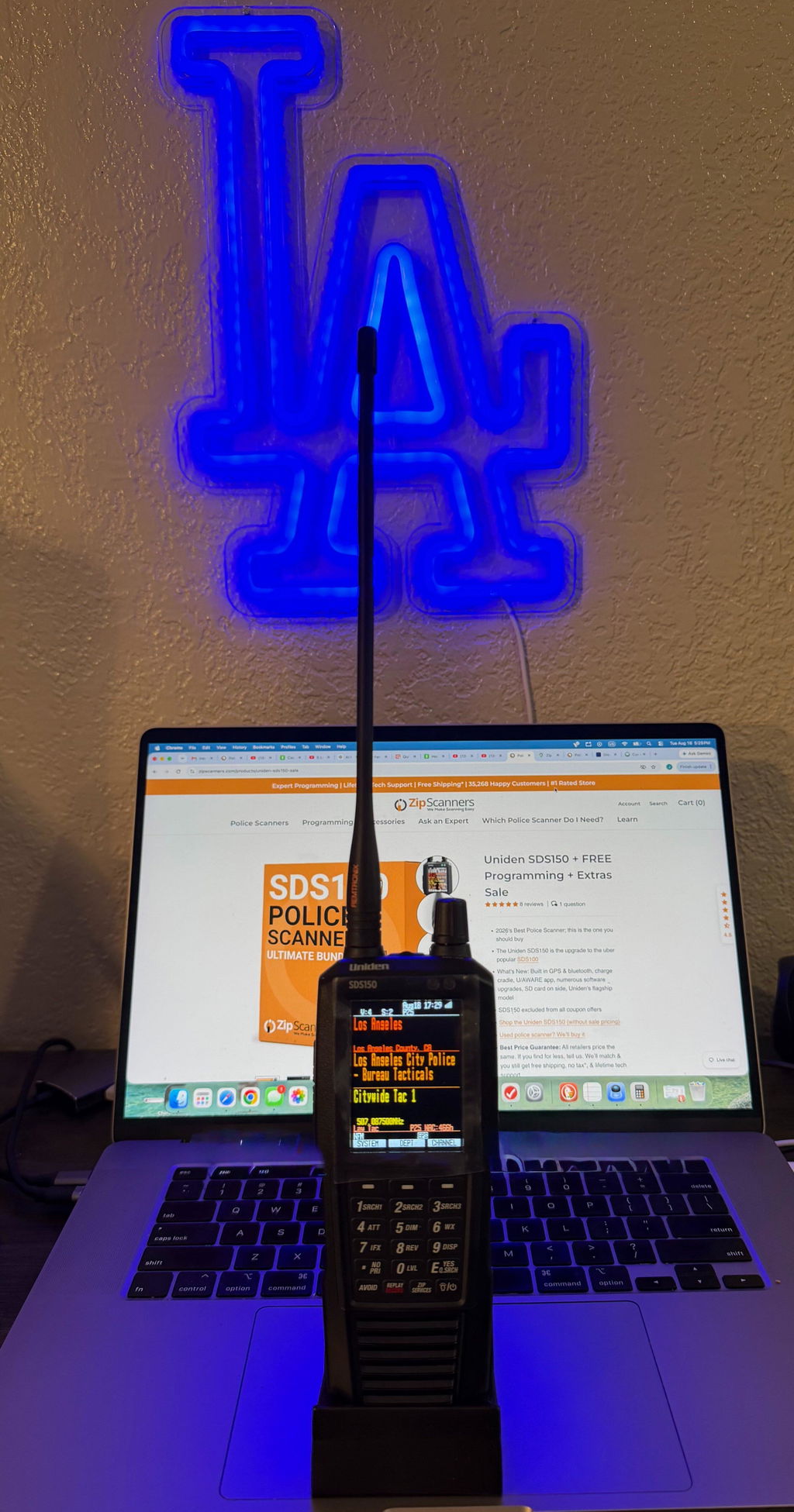
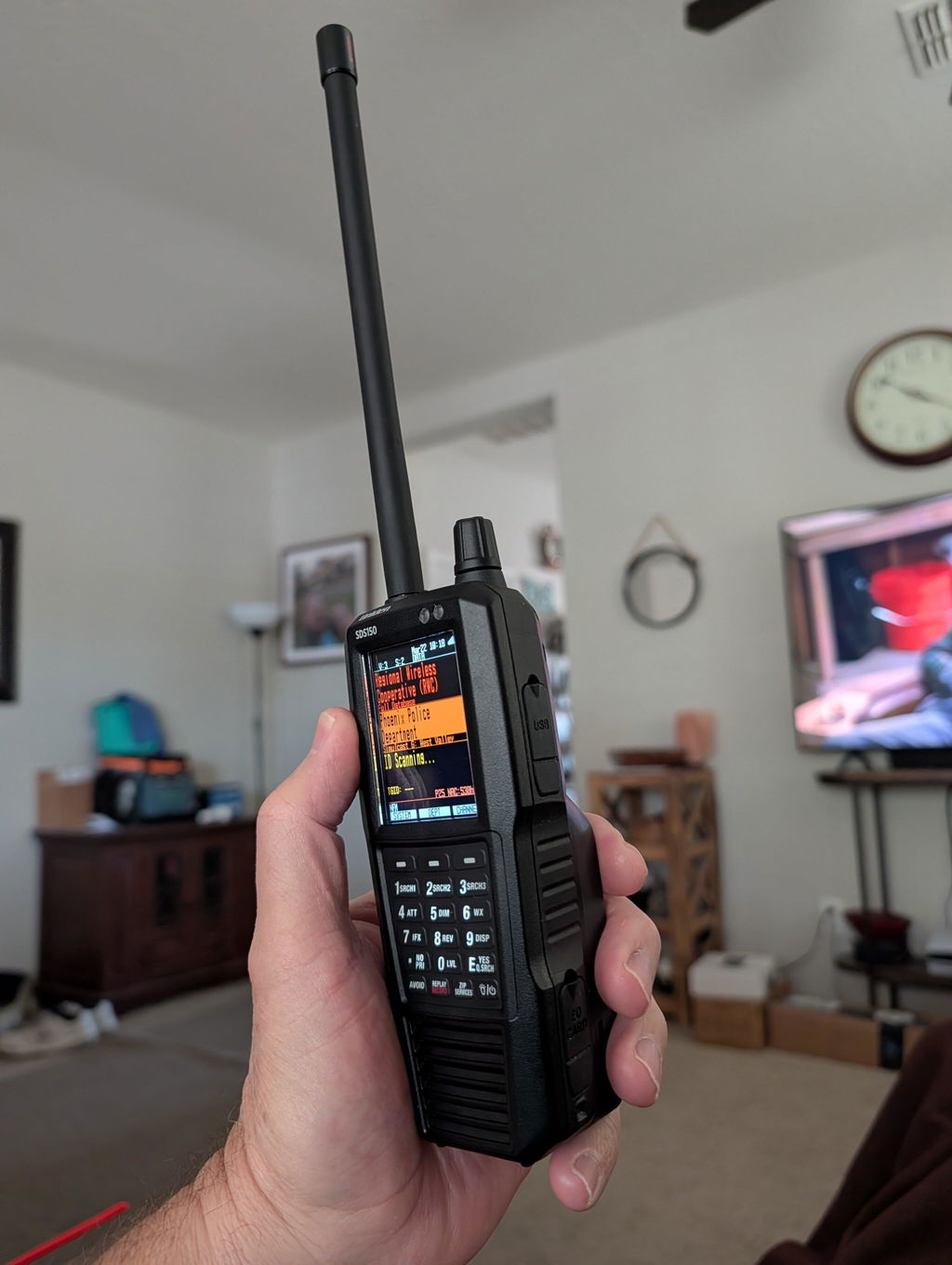
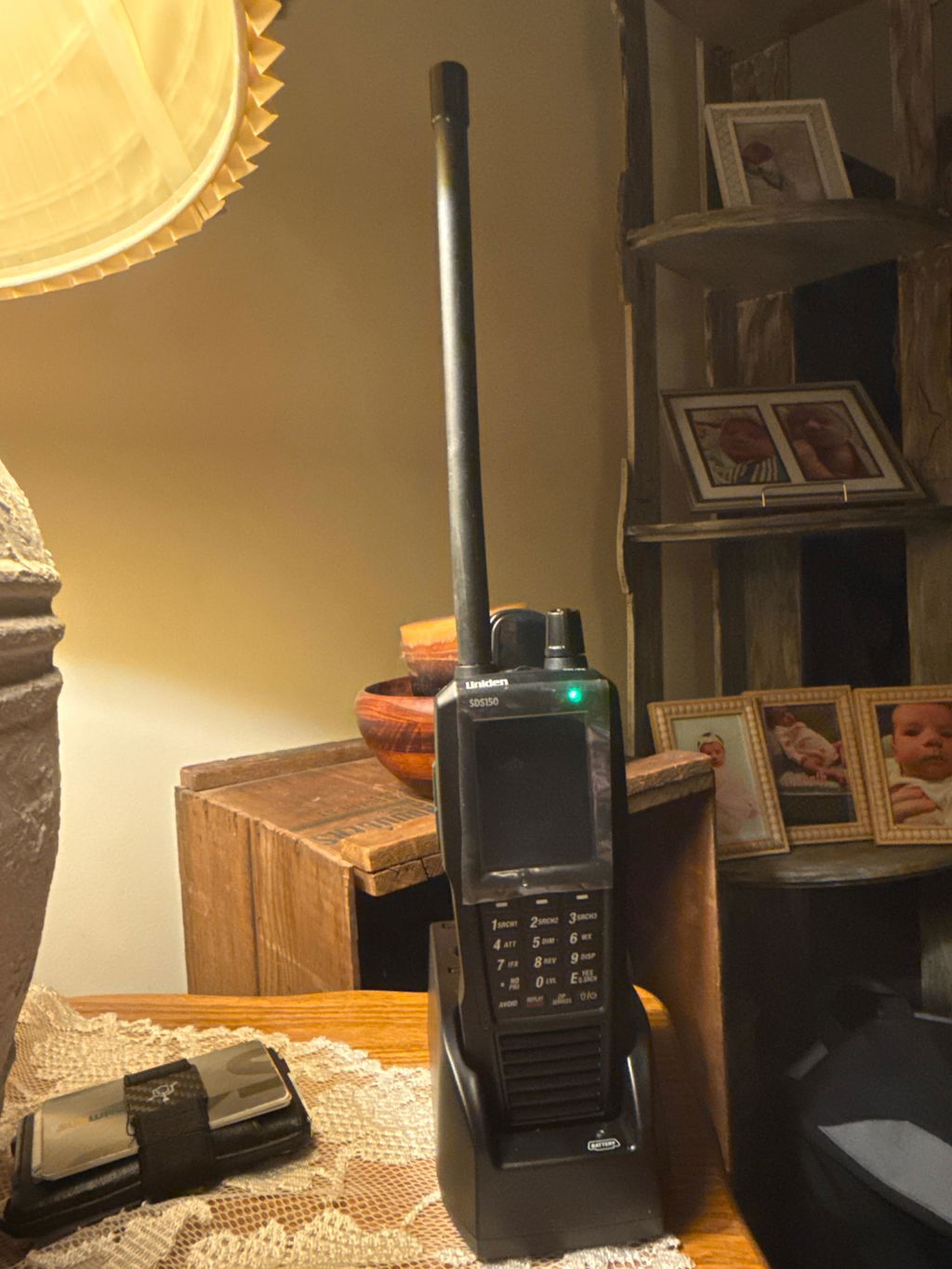
The SDS150 is the top scanner Uniden makes today and the one we recommend for anyone buying their first scanner in a major California metro. It carries the same True I/Q platform that made the SDS100 a legend in simulcast environments, then adds built-in GPS, the U/AWARE phone app, USB-C, a charging cradle, and Waterfall included out of the box.
- True I/Q SDR platform — handles simulcast distortion
- P25 Phase I and II, Motorola, EDACS, LTR trunking
- Built-in GPS for location-based scanning across county lines
- U/AWARE app: full control + audio from your phone
- Waterfall display included (no extra key needed)
- Optional upgrades: DMR, NXDN, ProVoice
Uniden SDS100 — Best Handheld Value
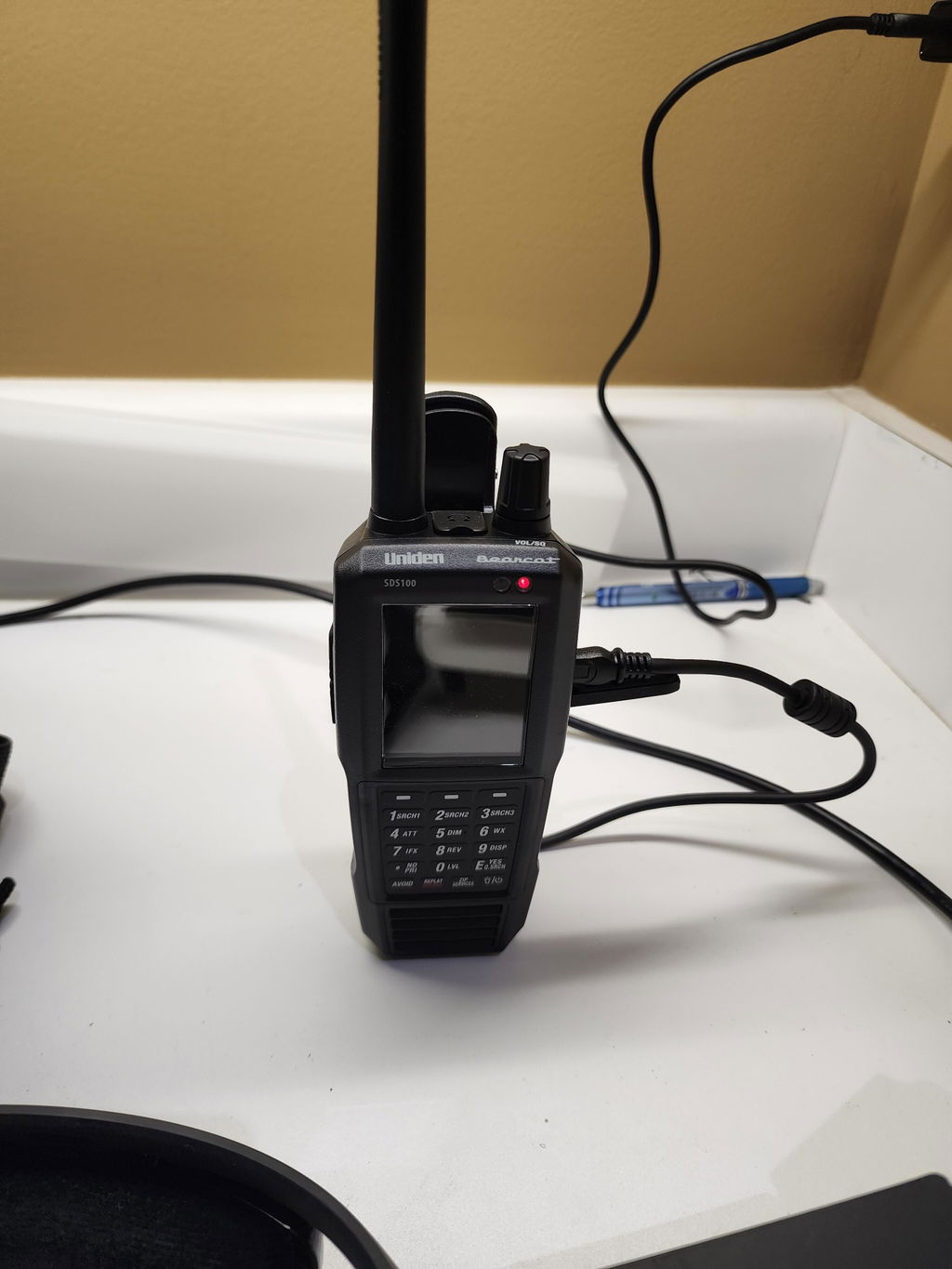
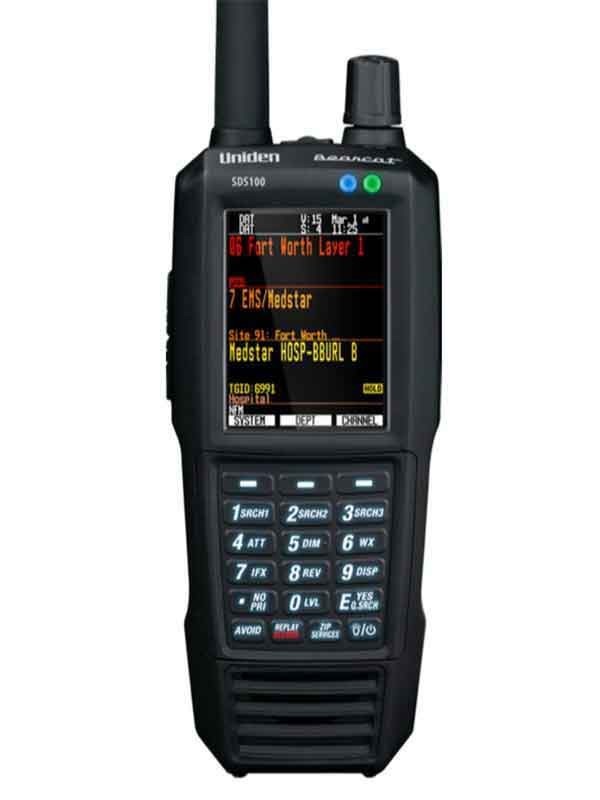
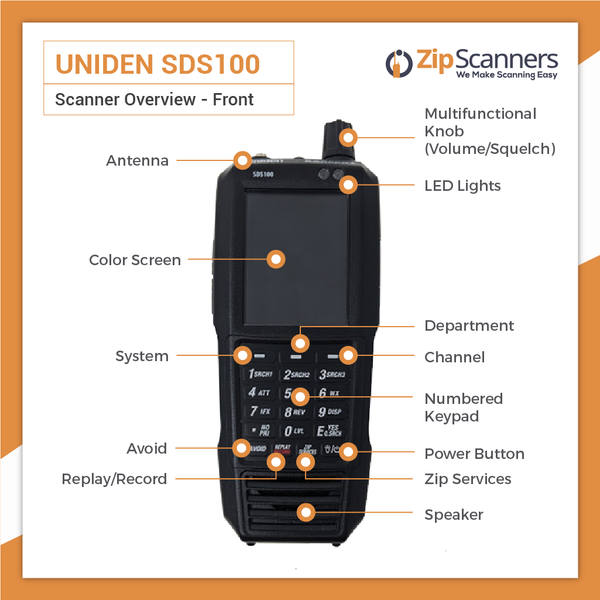
The SDS100 launched in 2018 and is still one of the best scanners ever made for simulcast. If budget matters more than built-in GPS and app integration, this is your move. Same True I/Q architecture. Same P25 Phase I/II performance. It is waterproof, compact, and it works everywhere in California where the SDS150 works.
- True I/Q SDR — same simulcast performance as the SDS150
- P25 Phase I and II, Motorola, EDACS, LTR trunking
- Waterproof housing
- External GPS supported (add-on puck)
- Waterfall available as a paid upgrade key
Not sure which is right for your county? Use our free Which Scanner Do I Need? tool. We will research your local systems, check simulcast and encryption status, and tell you exactly what to buy.
California Scanner Guide by County
The table below covers the major radio markets in California. System type, simulcast status, and encryption situation are based on current RadioReference data. Always verify your specific county before programming.
| County / Region | System Type | Simulcast | Law Enforcement |
|---|---|---|---|
| Los Angeles County | P25 Phase I/II, Conventional P25 | Yes (multi-site) | Partial Encryption |
| San Diego County | P25 Phase II (RCS NextGen) | Yes (simulcast cells) | SDPD Encrypted (June 2025) |
| Orange County | P25 Phase II | Yes | Fully Encrypted |
| Bay Area (SFBA) | P25 Phase II, Mixed systems | Yes | Mixed by Agency |
| Sacramento County | P25 Phase II | Yes | Some Encrypted |
| Riverside County | P25 Phase I/II | Some sites | Mixed |
| San Bernardino County | P25 Trunked | Some sites | Mixed |
| Fresno County | P25 Phase I/II | Limited | Largely Clear |
| Kern County | P25 Phase I, Conventional | Limited | Largely Clear |
| California Highway Patrol (statewide) | P25 Conventional + Trunked | No | Clear |
Data compiled from RadioReference.com. Encryption status current as of June 2026. Verify your county before programming.
Major County Deep Dives
Los Angeles County
LA is a patchwork. The city itself runs a mix of P25 conventional and trunked systems. LAPD uses digital P25 but is not on a countywide trunked network. The City of Los Angeles operates several trunked systems including the STRS (Simulcast Trunked Radio System) on P25 Phase II. Surrounding cities like Burbank, Glendale, and Pasadena are on their own trunked systems and audible without encryption.
The LA Sheriff's Department (LASD) runs a large countywide system with some encrypted talkgroups in specialized units. Fire and EMS remain largely accessible. This is a market where the SDS150 earns its price. The multi-site simulcast in the LA basin will break cheaper scanners with older analog-chip architectures. True I/Q is not optional here.
San Diego County
San Diego runs the RCS NextGen system, a P25 Phase II multi-site simulcast network. San Diego Police went fully encrypted in June 2025. New SDPD encrypted talkgroups replaced the old visible ones. San Diego Fire-Rescue, San Diego Sheriff, and many surrounding cities remain largely accessible on the RCS NextGen system. If you are in San Diego primarily to monitor police dispatch, know that SDPD is now silent to scanners. Fire, EMS, Sheriff, and surrounding agencies are still worth having a scanner for.
Source: RadioReference RCS NextGen system page
Bay Area (SFBA)
The Bay Area is one of the most RF-congested environments in California. Multiple counties run their own P25 Phase II systems with varying levels of encryption. BART Police, CHP, and many fire agencies are accessible. Oakland, San Jose, and San Francisco police talkgroup status varies by agency and is worth checking individually on RadioReference before buying a scanner or programming one. The density of systems also means a scanner without fast trunking will constantly lock onto the wrong system. Again, a reason True I/Q matters.
California Highway Patrol (Statewide)
CHP is one of the bright spots in California for scanner users. The state agency runs P25 conventional and some trunked systems statewide, largely in clear mode. CHP is one of the most consistently monitored agencies in the state and is accessible to any P25-capable scanner. Frequencies are listed on RadioReference's CHP page.
The Encryption Situation in California
This is the uncomfortable part. Encryption is a policy choice, not a technical requirement of P25. The P25 standard explicitly supports unencrypted clear mode. When an agency encrypts, someone decided to flip that switch. No consumer scanner in existence can defeat AES-256 encryption, and none ever will.
If RadioReference shows your local police talkgroups marked with an "E", no scanner or antenna upgrade will help. Your options are to monitor other agencies (fire, EMS, CHP, surrounding cities) or to get involved in local advocacy.
California has seen legislative discussion around scanner access for news media and the public. The Reporters Committee for Freedom of the Press has actively opposed blanket encryption. Several states have proposed or passed legislation addressing scanner encryption and press access, with California seeing bills around scanner access for news media. Those efforts have had limited success in reversing encryption trends so far.
The practical reality: Fire and EMS agencies have been slower to encrypt due to operational interoperability requirements between mutual aid jurisdictions. In most California counties, fire, EMS, and CHP remain accessible even where police have gone dark.
How to Program Your Scanner for California
Programming a scanner for a California P25 trunked system is not the same as entering a list of frequencies. Trunked systems require control channel frequencies, the system type, WACN/SYSID (for P25), and talkgroup IDs. Here is the correct process:
Go to radioreference.com, select California, then your county. Find your local trunked system. Note the system type (P25 Phase I or Phase II), the control channel frequencies, and the talkgroup list.
On the talkgroup list, any entry marked "E" or showing AES encryption is fully encrypted. Remove those from your programming list. Focus on fire, EMS, public works, and any law enforcement talkgroups not marked encrypted.
The Uniden Sentinel software lets you import RadioReference data directly. Download Sentinel, connect your SDS150 or SDS100 via USB, and import your county system. This saves hours compared to manual entry.
For the SDS150, enable the built-in GPS so the scanner automatically prioritizes systems near your current location as you move between counties. For the SDS100, attach an external GPS puck for the same functionality.
Every scanner purchased from Zip Scanners comes with free expert programming. We research your county, check encryption status, load the right systems and talkgroups, and ship it ready to go. You power it on and hear traffic.
Understanding P25 Phase II and Simulcast
These two terms come up constantly for California scanner buyers. Here is what they actually mean and why they matter for your purchase.
P25 Phase I vs Phase II
P25 Phase I uses FDMA (Frequency Division Multiple Access), where one voice call occupies one 12.5 kHz channel. Phase II upgrades to TDMA (Time Division Multiple Access), fitting two voice calls onto the same 12.5 kHz channel. Most major California systems have moved to Phase II. A scanner that only does Phase I will decode some Phase II transmissions incorrectly or miss them entirely. The SDS100 and SDS150 both handle Phase I and Phase II natively.
What Is Simulcast Distortion?
In a simulcast network, multiple tower sites transmit the same signal simultaneously. If your scanner picks up two of those sites at nearly the same signal strength, it receives two slightly time-delayed copies of the same signal. On analog systems, this causes a warbling sound. On digital P25 systems, it causes the decoder to fail entirely and you hear silence or noise instead of voice.
Traditional scanners use a dual-IF analog architecture that cannot handle this cleanly. The True I/Q platform in the SDS100 and SDS150 uses an SDR-based digital receiver that samples the RF signal differently, allowing it to reject the delayed copy and lock onto one clean signal. In heavy simulcast areas like the LA basin, this is the difference between a scanner that works and one that is useless.
"This scanner rocks. My area has simulcast distortion. My other scanner was not able to handle this. Works great and programmed and ready out of the box." — Verified Zip Scanners customer review
Do I Need DMR or NXDN Capability?
Most California public safety agencies use P25. DMR and NXDN are more common in commercial, business, and some smaller municipal systems. If you are focused on police, fire, and EMS in a California metro, P25 Phase I/II capability covers the vast majority of what you will want to monitor. DMR and NXDN unlock additional channels but are optional upgrades for most California users. Both the SDS150 and SDS100 support these as paid software upgrades through Uniden.
Get Scanner Alerts for Your County
New encryption rollouts. System upgrades. Programming tips for California. We email scanner news that actually matters to your area. No spam, unsubscribe any time.
Ready to Buy?
Every scanner sold by Zip Scanners ships with free expert programming, lifetime tech support, and a best price guarantee. We research your county before we ship. You get a scanner that works from the moment you power it on.
System information verified via RadioReference.com. Encryption status current as of June 2026 and subject to change. Always verify your local system before purchasing.