Police Codes & All Law-Enforcement Radio Codes (Full List)
Police radio codes began in the 1930s.
They kept chatter short on narrow AM channels.1
“10-4” is the celebrity, but 100+ signals exist.
Each agency tweaks them, so a “10-32” in Texas may differ from Georgia.
After 9/11, Homeland Security urged plain talk.
Yet codes survive because they’re fast, discreet, and muscle-memory.
Use the searchable charts below to decode any call.
Quick Jump
Police Codes Master List

Watch: Police Codes Explained
More explainers:
Police 10-Codes
APCO published the first list in 1940.
These signals still dominate patrol channels.


| Code | Meaning | Notes |
|---|---|---|
| 10-0 | Caution | Use with discretion |
| 10-1 | Unable to copy | Signal weak |
| 10-2 | Signal good | — |
| 10-3 | Stop transmitting | Cease radio traffic |
| 10-4 | Acknowledgment (OK) | Most famous |
| 10-5 | Relay | Transmit to another unit |
| 10-6 | Busy | Stand by |
| 10-7 | Out of service | Off duty / fuel |
| 10-8 | In service | Available |
| 10-9 | Repeat | Say again |
| 10-10 | Fight in progress | High priority |
| 10-11 | Dog case | Animal control |
| 10-12 | Stand by / Visitors present | Sensitive info |
| 10-13 | Weather conditions | Road report |
| 10-14 | Escort / Convoy | — |
| 10-15 | Prisoner in custody | — |
| 10-16 | Pick up prisoner | Transport request |
| 10-17 | Pick up papers | Documents |
| 10-18 | Urgent | Complete quickly |
| 10-19 | Return to station | HQ |
| 10-20 | Location | “What’s your 20?” |
| 10-21 | Call by telephone | Phone contact |
| 10-22 | Disregard | Cancel assignment |
| 10-23 | Arrived at scene | On location |
| 10-24 | Assignment completed | — |
| 10-25 | Report in person | Meet at HQ or scene |
| 10-26 | Detaining subject | Subject held |
| 10-27 | Driver-license info | Request check |
| 10-28 | Vehicle registration | Plate lookup |
| 10-29 | Check for wanted | Warrants / stolen |
| 10-30 | Illegal use of radio | Unnecessary traffic |
| 10-31 | Crime in progress | — |
| 10-32 | Man with gun | Armed subject |
| 10-33 | Emergency — stand by | Radio priority |
| 10-34 | Riot | Civil disturbance |
| 10-35 | Major crime alert | — |
| 10-36 | Correct time | Request / provide |
| 10-37 | Suspicious vehicle | Or subject |
| 10-38 | Stopping suspicious vehicle | Code 5 stop |
| 10-39 | Urgent — lights & siren | Code 3 |
| 10-40 | Silent run — no lights | Code 2 |
| 10-41 | Begin shift | — |
| 10-42 | End shift | — |
| 10-43 | Information | Message |
| 10-44 | Permission to leave | Break / coffee |
| 10-45 | Animal carcass | Road hazard |
| 10-46 | Assist motorist | Disabled vehicle |
| 10-47 | Emergency road repairs | — |
| 10-48 | Traffic standard repair | — |
| 10-49 | Traffic light out | — |
| 10-50 | Accident (F/PI/PD) | Fatal/Injury/Damage |
| 10-51 | Wrecker needed | Tow truck |
| 10-52 | Ambulance needed | — |
| 10-53 | Road blocked | — |
| 10-54 | Livestock on highway | — |
| 10-55 | Drunk driver | DUI suspect |
| 10-56 | Intoxicated pedestrian | — |
| 10-57 | Hit & run | — |
| 10-58 | Direct traffic | — |
| 10-59 | Convoy / escort | — |
| 10-60 | Squad in vicinity | — |
| 10-61 | Personnel in area | — |
| 10-62 | Reply to message | — |
| 10-63 | Prepare to copy | — |
| 10-64 | Message for local delivery | — |
| 10-65 | Net message assignment | — |
| 10-66 | Missing person | — |
| 10-67 | Clear to read net message | — |
| 10-68 | Dispatch information | — |
| 10-69 | Message received | — |
| 10-70 | Fire alarm | — |
| 10-71 | Advise nature of fire | — |
| 10-72 | Report progress of fire | — |
| 10-73 | Smoke report | — |
| 10-74 | Negative | No |
| 10-75 | In contact with | Subject / unit |
| 10-76 | En-route | — |
| 10-77 | ETA | Estimated arrival |
| 10-78 | Need assistance | Officer needs help |
| 10-79 | Notify coroner | — |
| 10-80 | Chase in progress | Pursuit |
| 10-81 | Breathalyser report | Intox test |
| 10-82 | Reserve lodging | — |
| 10-83 | School crossing duty | — |
| 10-84 | If meeting ___, advise ETA | — |
| 10-85 | Delayed due to ____ | — |
| 10-86 | Officer on duty | — |
| 10-87 | Pickup/distribute checks | — |
| 10-88 | Advise phone number | — |
| 10-89 | Bomb threat | — |
| 10-90 | Bank alarm | — |
| 10-91 | Prowler | — |
| 10-92 | Improperly parked vehicle | — |
| 10-93 | Blockade | Road closed |
| 10-94 | Drag racing | — |
| 10-95 | Prisoner in custody | — |
| 10-96 | Mental subject | — |
| 10-97 | Check (test) signal | Radio check |
| 10-98 | Assignment finished | Available |
| 10-99 | Wanted / stolen indicated | Hit confirmation |
Police 11-Codes
Western U.S. agencies bolt these traffic codes on top of the 10-series.

| Code | Meaning |
|---|---|
| 11-10 | Take report |
| 11-12 | Dead animal |
| 11-24 | Abandoned vehicle |
| 11-25 | Traffic hazard |
| 11-26 | Disabled vehicle |
| 11-27 | DL check – wants/warrants |
| 11-28 | Vehicle registration check |
| 11-40 | Advise if ambulance needed |
| 11-41 | Ambulance needed |
| 11-44 | Fatality (coroner) |
| 11-48 | Furnish transportation |
| 11-51 | Escort |
| 11-52 | Funeral detail |
| 11-54 | Suspicious vehicle |
| 11-55 | Officer being followed |
| 11-56 | Citizen being followed |
| 11-79 | TC – ambulance en-route |
| 11-80 | TC – major injury |
| 11-81 | TC – minor injury |
| 11-82 | TC – property damage |
| 11-83 | TC – unknown injuries |
| 11-84 | Direct traffic |
| 11-85 | Tow truck needed |
| 11-86 | Special detail |
| 11-87 | Assist fire department |
| 11-98 | Meet at location |
| 11-99 | Officer needs help (urgent) |
Police Code Signals
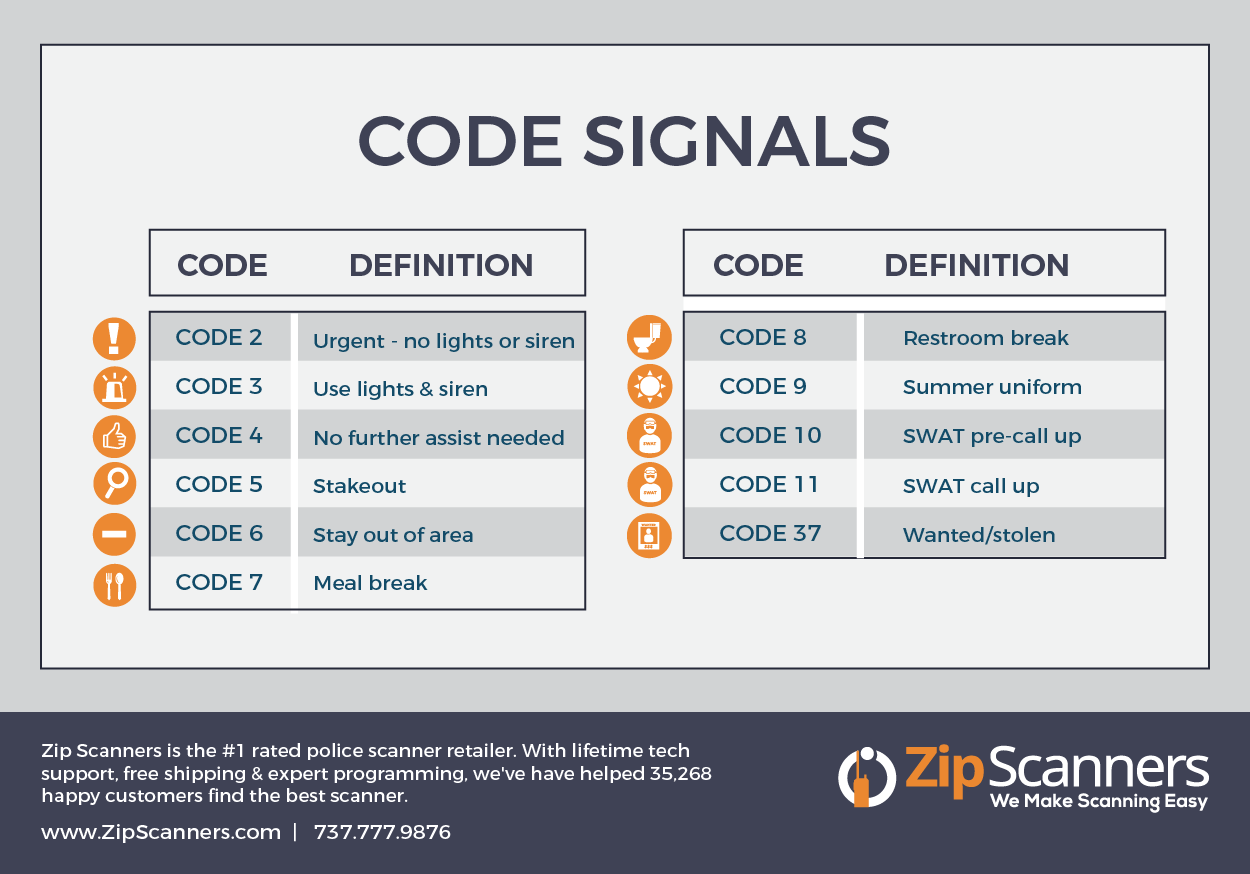
Signal calls replace 10-codes in many regions for brevity.
| Signal | Meaning |
|---|---|
| 1 | Drunk driver |
| 2 | Intoxicated person |
| 3 | Hit & run |
| 4 | Accident |
| 5 | Murder |
| 6 | Escaped prisoner |
| 7 | Dead body |
| 8 | Missing person |
| 9 | Stolen vehicle |
| 10 | Stolen items |
| 11 | Hit & run – injury |
| 12 | Reckless driving |
| 13 | Suspicious person |
| 14 | Information |
| 15 | Special detail |
| 16 | Domestic disturbance |
| 17 | Complaint |
| 18 | Felony in progress |
| 19 | Misdemeanor |
| 20 | Mental subject |
| 21 | Burglary in progress |
| 22 | Disturbance |
| 23 | Hold-up |
| 24 | Prowler |
| 25 | Fire |
| 26 | Detain subject |
| 27 | License check |
| 28 | Registration check |
| 29 | Reckless driver |
| 30 | Bomb threat |
| 31 | Crime in progress |
| 32 | Gun involved |
| 33 | Emergency — radio silence |
| 34 | Assault |
| 35 | Rape |
| 36 | Shooting |
| 37 | Stabbing |
| 38 | Officer in danger |
| 39 | Road block |
| 40 | Fight |
| 50 | Dispatch duty |
| 60 | Open door / window |
| 70 | Improper parking |
| 80 | Explosion |
| 90 | Hostage situation |
| 100 | Resume normal traffic |
Phonetic Alphabet
The NATO phonetic alphabet standardized voice-code words to ensure crystal-clear spelling over radio.

| Letter | Word |
|---|---|
| A | Alpha |
| B | Bravo |
| C | Charlie |
| D | Delta |
| E | Echo |
| F | Foxtrot |
| G | Golf |
| H | Hotel |
| I | India |
| J | Juliett |
| K | Kilo |
| L | Lima |
| M | Mike |
| N | November |
| O | Oscar |
| P | Papa |
| Q | Quebec |
| R | Romeo |
| S | Sierra |
| T | Tango |
| U | Uniform |
| V | Victor |
| W | Whiskey |
| X | X-ray |
| Y | Yankee |
| Z | Zulu |
Frequently Asked Questions
What are police 10-codes?
Short numbered signals (10-0 → 10-99) that compress common phrases such as “10-4 = OK”.
Do all agencies use the same codes?
No — states and even neighboring cities tweak meanings.
Why did DHS recommend plain language?
To avoid mis-communication between multiple agencies responding to the same event.
What does “Signal 100” mean?
Emergency — radio silence. Only critical traffic allowed.
How do I find my local code set?
Check your agency’s website or ask the records division; many publish PDFs.
Are codes being phased out?
Some have switched to plain talk, but many agencies still rely on codes for brevity.
What’s the diff between 10-, 11- and penal codes?
10/11 = radio signals; penal codes reference criminal statutes (e.g., “PC 211” = robbery).
Where did “10-4 good buddy” come from?
1970s CB-radio trucker slang popularised by TV shows.
Why do some codes have letter suffixes?
Suffixes clarify severity — “10-50 F” = crash with fatality.
What does 10-33 traffic mean?
Radio emergency — units should clear the air for priority traffic.
Is 10-20 used outside the U.S.?
Yes — Canadian and some EU agencies adopted it via CB culture.
Are codes encrypted?
No — encryption scrambles voice; codes are just shorthand.
What does “10-100” mean on CB?
Trucker slang for “bathroom break” — not an official police code..
Do Fire/EMS use the same codes?
Often share logistics codes (10-7, 10-8) but have unique medical signals.